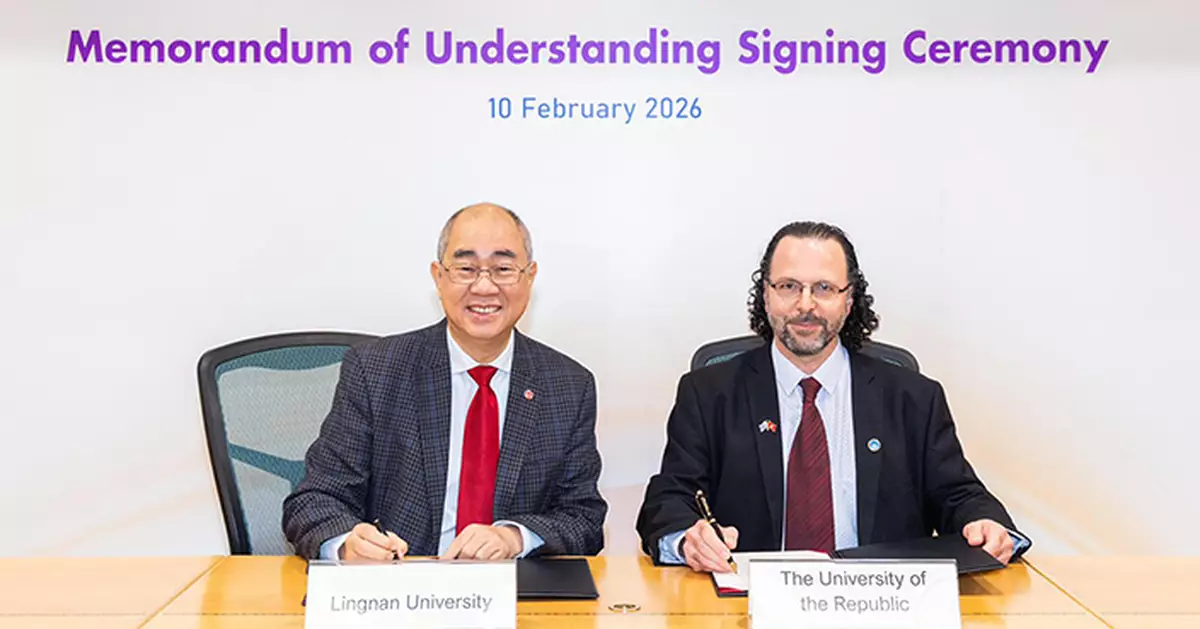
Lingnan University and the Universidad de la República (University of the Republic, UdelaR), the largest public higher education institution in Uruguay, signed a Memorandum of Understanding (MoU) on 10 February 2026 on Lingnan campus, formally establishing an academic partnership. This is an important step in advancing academic cooperation between Lingnan and universities in South America.

Prof S. Joe Qin, President and Wai Kee Kau Chair Professor of Data Science, welcomes the delegation, introduces them to the university, and explores opportunities for collaboration during the meeting.
Prof Héctor Cancela, President of the UdelaR, and Mr Federico Lage, Consul-General of Uruguay in the Hong Kong SAR, led a delegation to Lingnan University, where they were welcomed by Prof S. Joe Qin, President and Wai Kee Kau Chair Professor of Data Science of Lingnan University, Prof Raymond Chan Hon-fu, Vice-President (Academics) cum Provost and Lam Man Tsan Chair Professor of Scientific Computing, Prof Xin Yao, Vice-President (Research and Innovation) and Tong Tin Sun Chair Professor of Machine Learning, Prof Zhang Dian, Associate Dean of the School of Data Science and Person-in-Charge of the Division of Industrial Data Science, Prof Jean-Michel Morel, Chair Professor of the Division of Industrial Data Science, and Prof Bradley R. Barnes, Special Advisor to President on Internationalization and Director of Global Education.
President S Joe Qin said, “Lingnan University is committed to supporting the vision of the Hong Kong Special Administrative Region of the People’s Republic of China in developing Hong Kong into an international post-secondary education hub and promoting the ‘Study in Hong Kong’ brand. In response to changing times, the University has in recent years integrated artificial intelligence and data science elements across various disciplines, advancing its distinctive ‘Liberal Arts + Technology’ development model. More than 20 per cent of our academic and research staff were recognised by Stanford University in 2025 as being among the world’s top 2% of scientists. We look forward to working with the Universidad de la República to leverage the strengths of both institutions, advancing interdisciplinary research collaboration and developing innovative solutions to pressing global challenges.”
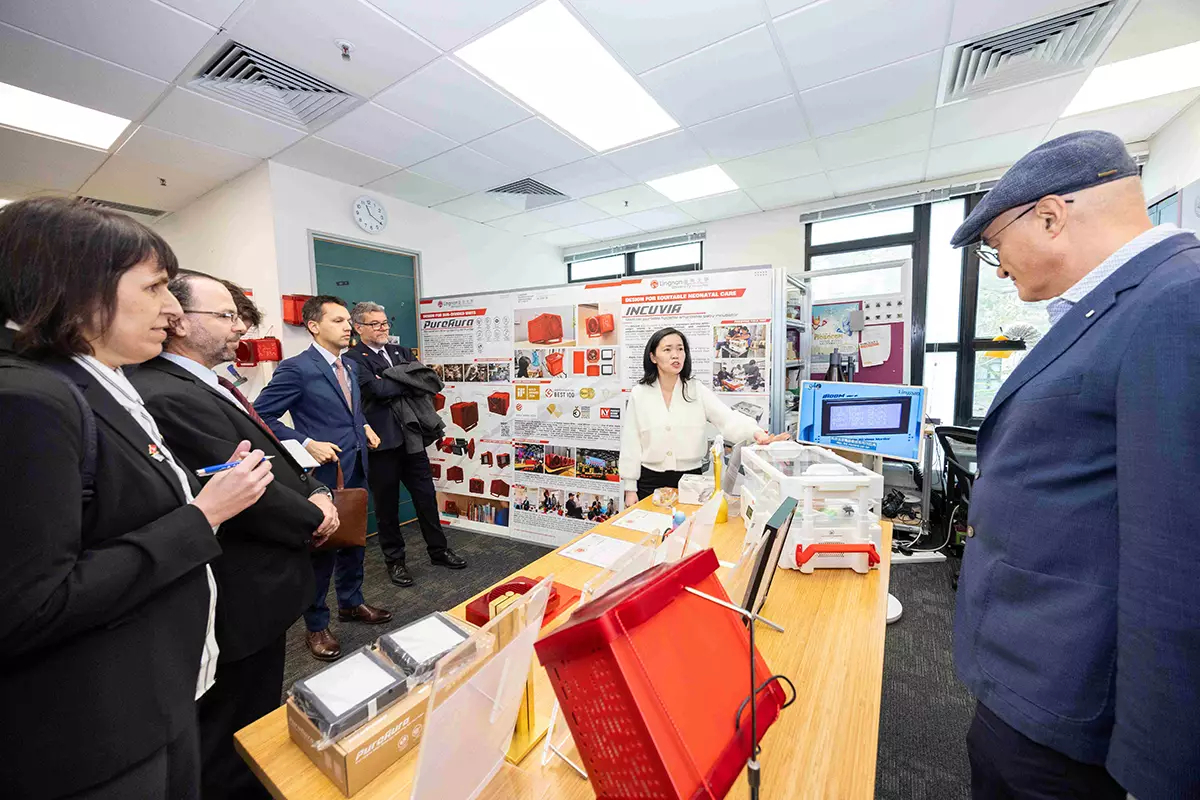
The delegation visits the Lingnan campus and the Lingnan Entrepreneurship Initiative (LEI).
The signing ceremony was chaired by Prof Raymond Chan Hon-fu and Prof Héctor Cancela, and attended by senior representatives of both universities. Prof Chan said “Lingnan University actively establishes partnerships with leading universities worldwide. To date, we have set up academic collaborations with over 280 institutions across Asia, Europe, the Americas and Africa. UdelaR is the oldest public university in Uruguay, and this will open up valuable networks, academic resources, and exchanges between researchers in Lingnan and South America, making the most of both universities’ strengths, and improving knowledge transfer.”
In the MoU, the two universities will establish a framework for academic exchange and cooperation in research, and explore potential areas of collaboration, including the exchange of academic and research staff, possible student exchange, and joint academic research and publication in fields of interest to both. The partnership aims to expand cross-regional academic networks.
The UdelaR delegation toured the Lingnan campus and the Lingnan Entrepreneurship Initiative (LEI), gaining an understanding of the University’s innovation and entrepreneurship ecosystem, which encourages faculty and students from different disciplines to design innovative humanitarian technologies together, and teaches students to address social issues through pivotal research.
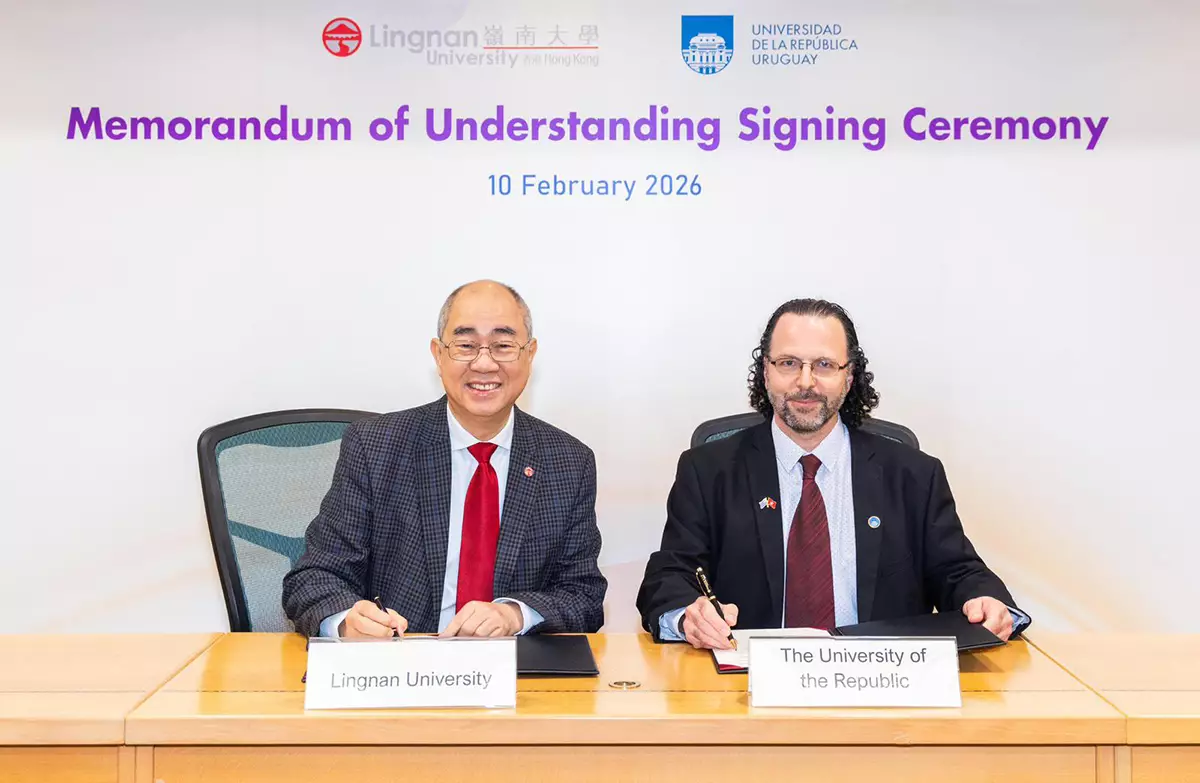
Lingnan University and the Universidad de la República (University of the Republic, Udelar) sign a Memorandum of Understanding. The ceremony is officiated by Prof Raymond Chan Hon-fu, Vice-President (Academics) cum Provost and Lam Man Tsan Chair Professor of Scientific Computing of Lingnan University (left), and Prof Héctor Cancela, President of the Udelar (right), with senior representatives of both universities attending the event.
Lingnan University has made considerable progress in recent years, and came first globally under the United Nations Sustainable Development Goal SDG 4 (Quality Education) in the Times Higher Education (THE) World University Impact Rankings 2025, the first university in the Hong Kong SAR to achieve a global first in any UN SDG. Lingnan was also in the Times Higher Education (THE) World University Rankings 2026 for the first time, one of the top 301–350 universities worldwide out of 2,191 institutions, its international outlook rated 47th. Universidad de la República (University of the Republic, Udelar) is consistently ranked as the top university in Uruguay and a premier public institution in Latin America, holding a #650 position in the 2026 QS World University Rankings.
Lingnan University held its 2026/27 academic year New Student Orientation (NSO) and Official Welcome for undergraduate students at its Tuen Mun campus today (24 August).
Prof S. Joe Qin, President and Wai Kee Kau Chair Professor of Data Science at Lingnan University, officiated at the University’s Official Welcome and greeted incoming undergraduate students from the Hong Kong SAR, the Chinese Mainland, and overseas. This year’s cohort includes students from a wide range of countries and regions, including Russia, Bhutan, Mongolia, Kazakhstan, Uzbekistan, Kyrgyzstan, Tajikistan, Nepal, Pakistan, Ethiopia, and the Philippines.
In his remarks, President Qin said the University is committed to welcoming students from diverse backgrounds and cultures. He noted that the geographical diversity of the student intake has further expanded this year, with Lingnan admitting non-local freshmen from Ethiopia for the first time, underscoring the University’s diverse, inclusive and international campus.
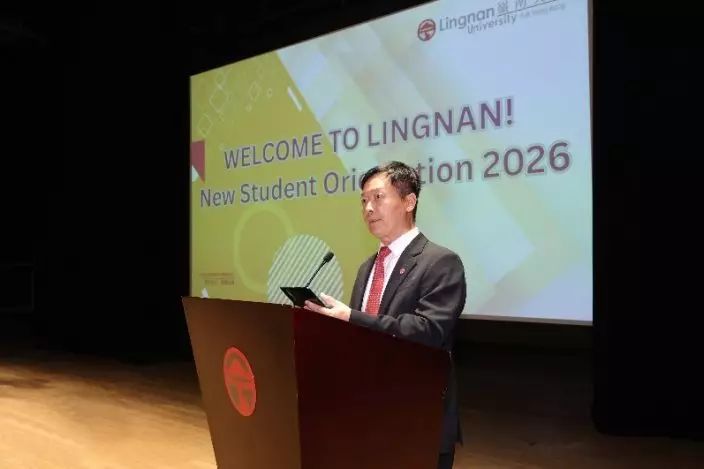
Prof S. Joe Qin, President and Wai Kee Kau Chair Professor of Data Science, officiated at the Official Welcome and stated that the University warmly welcomed the new students from diverse backgrounds and cultures into the Lingnan community.
President Qin said, “I believe that every student harbours unique dreams and potential and looks forward to finding their own stage at the University. Lingnan is committed to providing an interdisciplinary learning environment and diverse opportunities for development, supporting students in pursuing excellence in academics, innovation, and personal growth. Launched this academic year, the Samuel C.C. Ting Elite Class will provide selected students with comprehensive learning resources, including a four-year full tuition scholarship and a full accommodation subsidy, priority access to cutting-edge research projects, and artificial intelligence (AI) training offered by leading global enterprises, culminating in professional certification. The University will continue to refine its scholarships and talent-development programmes to help students chart a suitable formative path at Lingnan and make the most of their strengths.”
President Qin added that demand for Lingnan among JUPAS applicants has grown significantly. For three consecutive years since 2024, Lingnan University has recorded the highest growth in JUPAS Band A applications among Hong Kong’s eight UGC-funded universities, with a cumulative increase of 88%. In the 2026/27 admission cycle, Lingnan’s mean JUPAS admission score increased by 6.7%, the largest increase among all eight UGC-funded universities. The Bachelor of Business Administration (Honours) in Business Analytics and Innovation programme was the most competitive programme in Hong Kong, with a 77-to-1 application-to-admission ratio. The average JUPAS admission score for the Bachelor of Science (Honours) in Data Science programme reached 20.8, which is 2.7 points higher than last year. For Chinese Mainland Gaokao students, the highest admitted score at Lingnan was 129 points above the Batch 1 or Special Admission cut-off score across provinces and cities, an increase of 18 points over 2025.
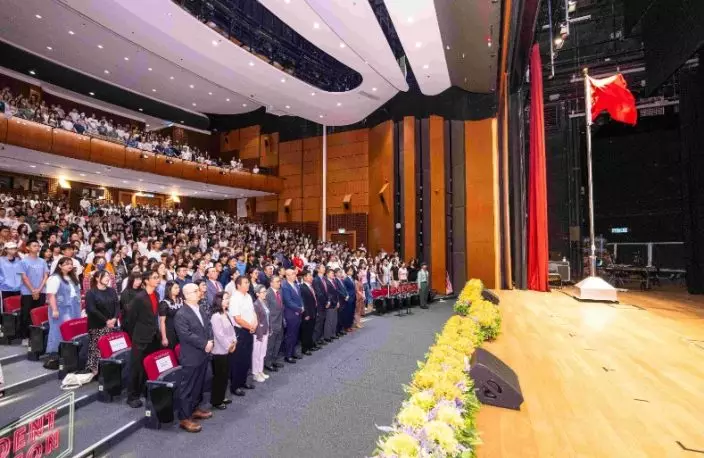
The national flag-raising ceremony is conducted during the Official Welcome.
Lingnan has made significant leaps in international rankings in recent months, reinforcing its position as a leading research-oriented liberal arts university comprehensive in arts and sciences in the digital era. In the Times Higher Education (THE) Sustainability Impact Ratings 2026, Lingnan was in the global top 100 for the first time, and 63rd overall, with first place in the Hong Kong SAR in six Sustainable Development Goals (SDGs). It retained its World No. 1 ranking in "SDG 4: Quality Education", and came first in the Hong Kong SAR in "SDG 1: No Poverty", "SDG 2: Zero Hunger", "SDG 8: Decent Work and Economic Growth", "SDG 10: Reduced Inequalities", and "SDG 17: Partnerships for the Goals".
Lingnan also came 84th in its debut appearance in the THE Asia University Rankings, and in the QS World University Rankings 2027 it climbed sharply by over 120 places to 581st, its largest upward leap in recent years.
To help freshmen adapt to university life early and foster a sense of belonging, Lingnan has been running online orientation sessions and activities since mid-July, helping students build social networks and integrate swiftly into campus life. On the day of the inauguration ceremony, it launched the Kaleidoscope Programme, tailored for newcomers with library and campus tours, sports facilities briefings, and workshops on hostel life explaining campus resources and facilities. Themed seminars have covered scholarship applications, academic exchanges, service-learning, and student-led community service, and distinguished alumni have shared inspiring stories, suggesting new students plan their objectives in advance and build up their confidence and preferences.
During the NSO, core administrative units briefed the freshmen, giving them practical information so they could familiarise themselves with university resources, use AI for independent learning, and master learning opportunities. After several specialist sessions, the finale featured performances by the Dancing and Music Societies, sparkling with youthful campus vigour and opening the curtain on a vibrant university life.
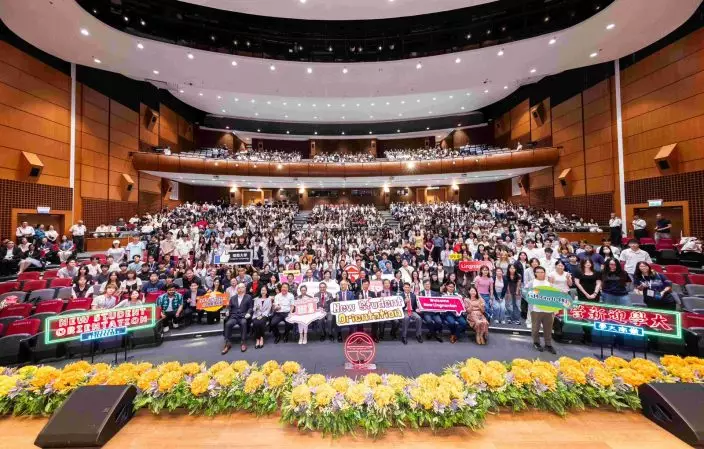
Lingnan University held its 2026/27 academic year New Student Orientation and Official Welcome on campus today, welcoming a record intake of about 1,500 new undergraduates into the Lingnan community.
The orientation activities also placed a strong emphasis on community cohesion, with the University arranging for freshmen to interact with departments and societies related to their major subjects and meet their wardens. Representatives from various departmental societies shared tips on subject selection, extracurricular activities, and learning opportunities, fostering interaction among students across different departments. Meanwhile, the University’s Peer Mentoring Programme was launched on the same day, pairing new undergraduates with senior student mentors to help them adjust to university life and actively engage in campus activities.
Lingnan will also host the Campus Life Carnival on the evening of 3 September to encourage freshmen to integrate. Student bodies, sports teams, and several departments will set up over 40 promotional booths providing practical information on extracurricular activities, and recommending ways to expand their social networks to help them settle into the Lingnan community more swiftly.